
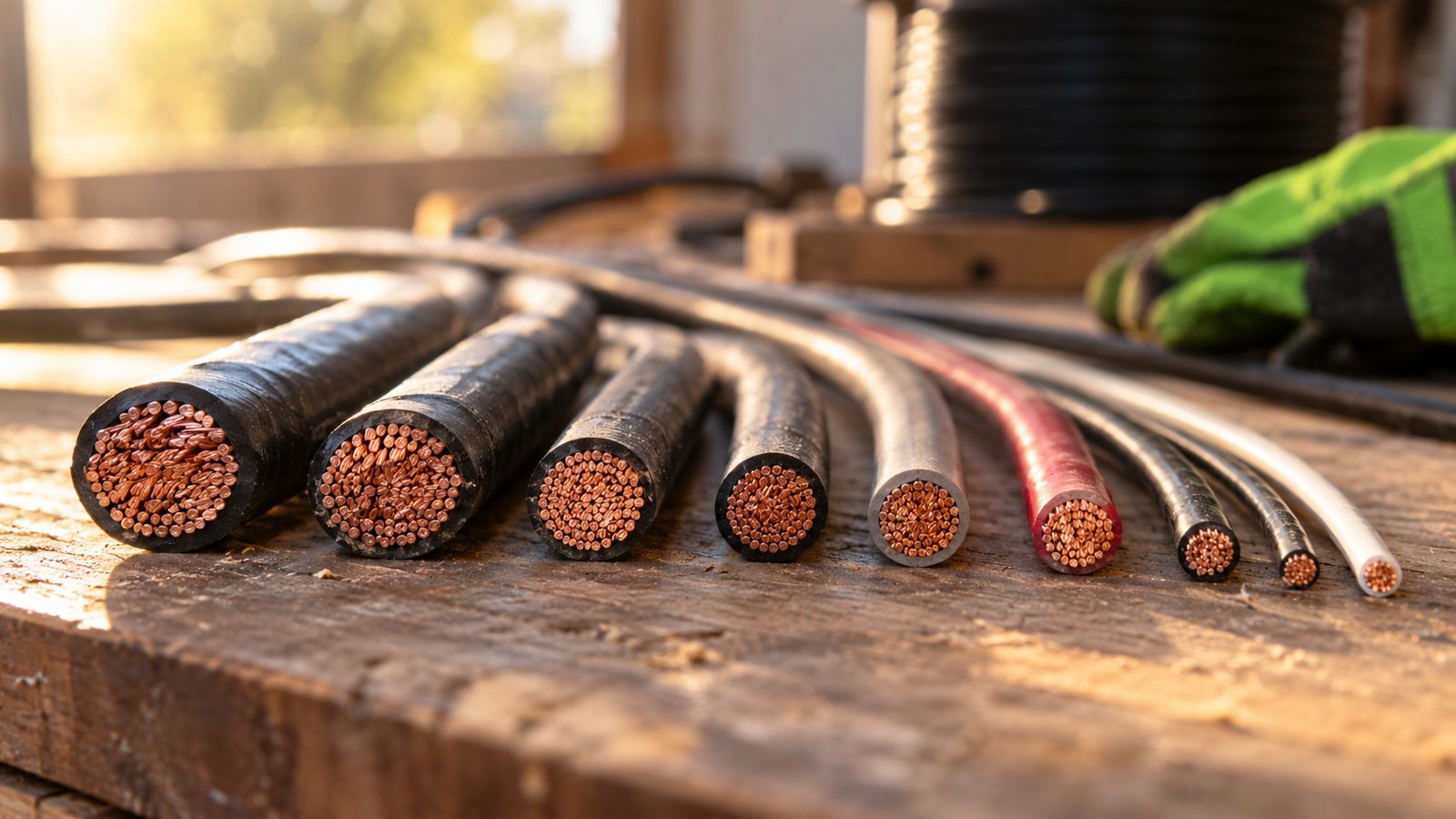
Wire gauge chart (AWG)
Not sure what size wire you need? Find the width and resistance for every AWG size here. It's free, there's no sign-up, and no squinting at the spool.
Checked 2026-10-19
Wire gauge in short
- AWG numbers run backward. A bigger number means a thinner wire.1
- The chart lists diameter, circular mils, area and resistance for each size.
- It gives the size of the wire and its resistance. It does not say how much current a wire may carry. Your local code and the label on your equipment decide that.
Hold the wire
Tap a size and see it to scale next to the last one you held.
Pick one. I'll hold the flashlight.
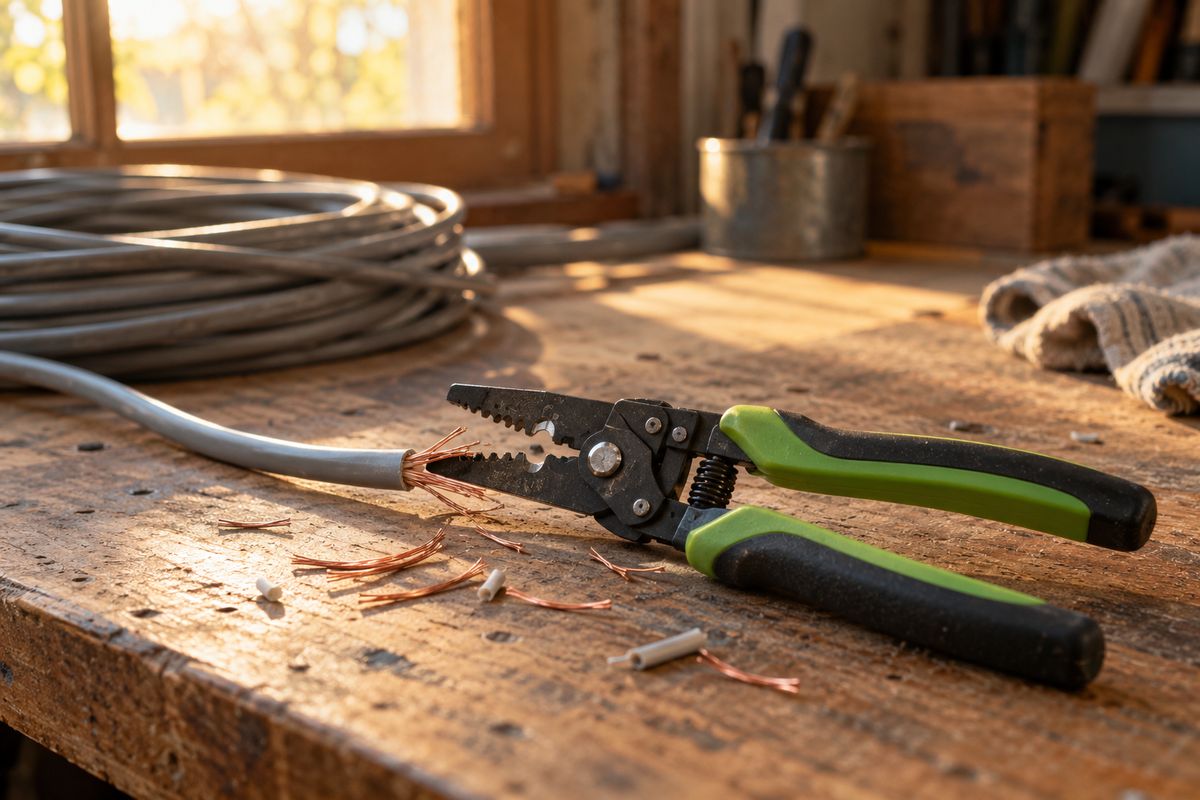
Three sizes to start with
Tap a card to turn it over.
Guess before you flip. Thicker or thinner?
-
Is 14 AWG thicker or thinner than 12 AWG?
-
Is 12 AWG thicker or thinner than 10 AWG?
-
Is 10 AWG thicker or thinner than 14 AWG?
The full chart
| Size | Diameter (in) | Circular mils | Area (mm2) |
|---|---|---|---|
| 4/0 AWG | 0.4600 | 211,600 | 107.22 |
| 3/0 AWG | 0.4096 | 167,806 | 85.03 |
| 2/0 AWG | 0.3648 | 133,077 | 67.43 |
| 1/0 AWG | 0.3249 | 105,535 | 53.48 |
| 1 AWG | 0.2893 | 83,693 | 42.41 |
| 2 AWG | 0.2576 | 66,371 | 33.63 |
| 3 AWG | 0.2294 | 52,635 | 26.67 |
| 4 AWG | 0.2043 | 41,741 | 21.15 |
| 5 AWG | 0.1819 | 33,102 | 16.77 |
| 6 AWG | 0.1620 | 26,251 | 13.30 |
| 7 AWG | 0.1443 | 20,818 | 10.55 |
| 8 AWG | 0.1285 | 16,510 | 8.37 |
| 9 AWG | 0.1144 | 13,093 | 6.63 |
| 10 AWG | 0.1019 | 10,383 | 5.26 |
| 11 AWG | 0.0907 | 8,234 | 4.17 |
| 12 AWG | 0.0808 | 6,530 | 3.31 |
| 13 AWG | 0.0720 | 5,178 | 2.62 |
| 14 AWG | 0.0641 | 4,107 | 2.08 |
| 15 AWG | 0.0571 | 3,257 | 1.65 |
| 16 AWG | 0.0508 | 2,583 | 1.31 |
| 17 AWG | 0.0453 | 2,048 | 1.04 |
| 18 AWG | 0.0403 | 1,624 | 0.82 |
| 19 AWG | 0.0359 | 1,288 | 0.65 |
| 20 AWG | 0.0320 | 1,022 | 0.52 |
| 22 AWG | 0.0253 | 642 | 0.33 |
| 24 AWG | 0.0201 | 404 | 0.20 |
| Size | Ohms per 1,000 ft |
|---|---|
| 4/0 AWG | 0.049 |
| 3/0 AWG | 0.062 |
| 2/0 AWG | 0.078 |
| 1/0 AWG | 0.098 |
| 1 AWG | 0.124 |
| 2 AWG | 0.156 |
| 3 AWG | 0.197 |
| 4 AWG | 0.248 |
| 5 AWG | 0.313 |
| 6 AWG | 0.395 |
| 7 AWG | 0.498 |
| 8 AWG | 0.628 |
| 9 AWG | 0.792 |
| 10 AWG | 0.999 |
| 11 AWG | 1.260 |
| 12 AWG | 1.588 |
| 13 AWG | 2.003 |
| 14 AWG | 2.525 |
| 15 AWG | 3.184 |
| 16 AWG | 4.015 |
| 17 AWG | 5.063 |
| 18 AWG | 6.385 |
| 19 AWG | 8.051 |
| 20 AWG | 10.152 |
| 22 AWG | 16.143 |
| 24 AWG | 25.668 |
| Size | Ohms per 1,000 ft |
|---|---|
| 4/0 AWG | 0.080 |
| 3/0 AWG | 0.101 |
| 2/0 AWG | 0.128 |
| 1/0 AWG | 0.161 |
| 1 AWG | 0.203 |
| 2 AWG | 0.256 |
| 3 AWG | 0.323 |
| 4 AWG | 0.407 |
| 5 AWG | 0.514 |
| 6 AWG | 0.648 |
| 7 AWG | 0.817 |
| 8 AWG | 1.030 |
| 9 AWG | 1.299 |
| 10 AWG | 1.637 |
| 11 AWG | 2.065 |
| 12 AWG | 2.604 |
| 13 AWG | 3.283 |
| 14 AWG | 4.140 |
| 15 AWG | 5.220 |
| 16 AWG | 6.583 |
| 17 AWG | 8.301 |
| 18 AWG | 10.467 |
| 19 AWG | 13.199 |
| 20 AWG | 16.644 |
| 22 AWG | 26.464 |
| 24 AWG | 42.080 |
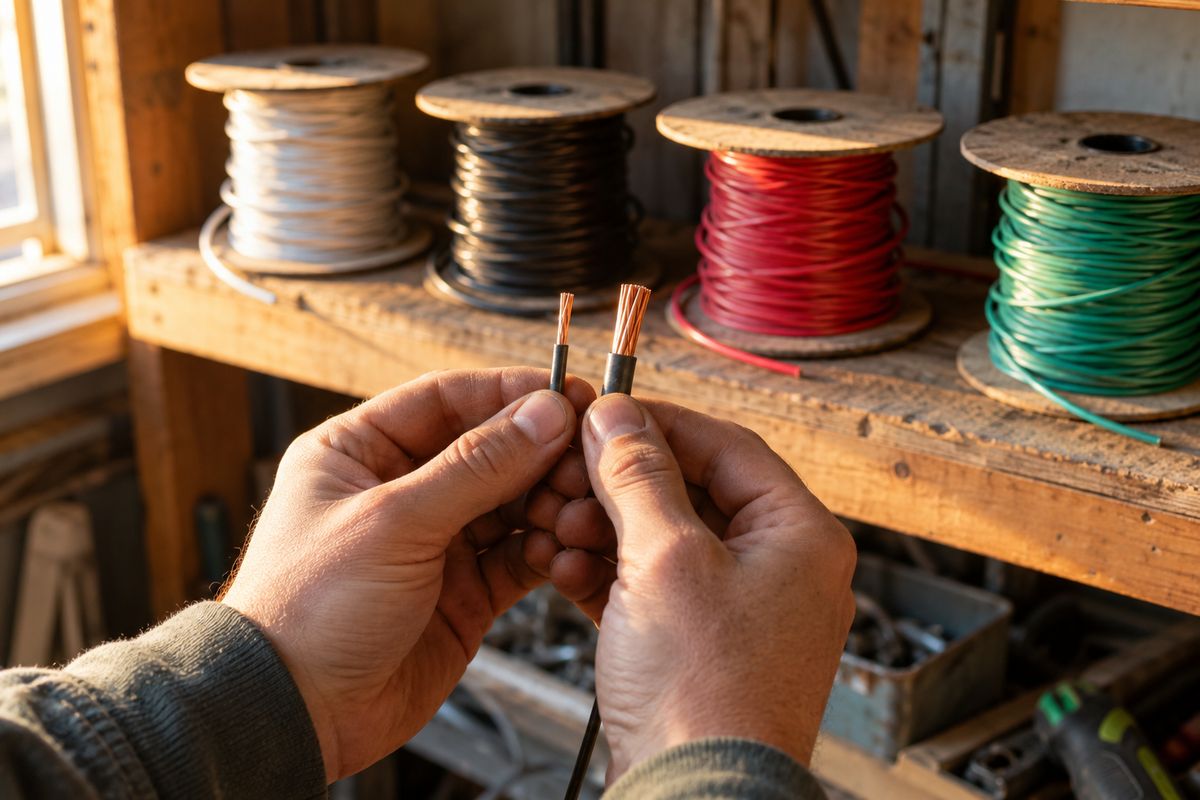
Speed round: which wire is thicker?
Ten quick picks. No timer. Just try to beat your last score.
Ten picks. No clock. Just you and your high score.
Which wire is thicker?
Where the wire numbers come from
Diameter (mils) = 5 x 92^((36 - n) / 39) Circular mils = diameter squared Ohms per 1,000 ft = 10.371 x 1,000 / circular mils12
Worked example
- Start with the gauge number n. For 10 AWG, n = 10.
- Diameter in mils = 5 x 92^((36 - 10) / 39) = 5 x 92^0.6667 = 101.9 mils, which is 0.1019 inch.
- Circular mils = diameter in mils squared = 101.9 x 101.9, about 10,383.
- Resistance per 1,000 feet = 10.371 x 1,000 / 10,383 = 0.999 ohms for copper at 20 C.
More for the truck
- Voltage drop calculatorCheck a size you already picked.
- Conduit bending chartOffset multipliers and shrink.
- Print this chartThe print view drops the menu and buttons.
Print it for the truck
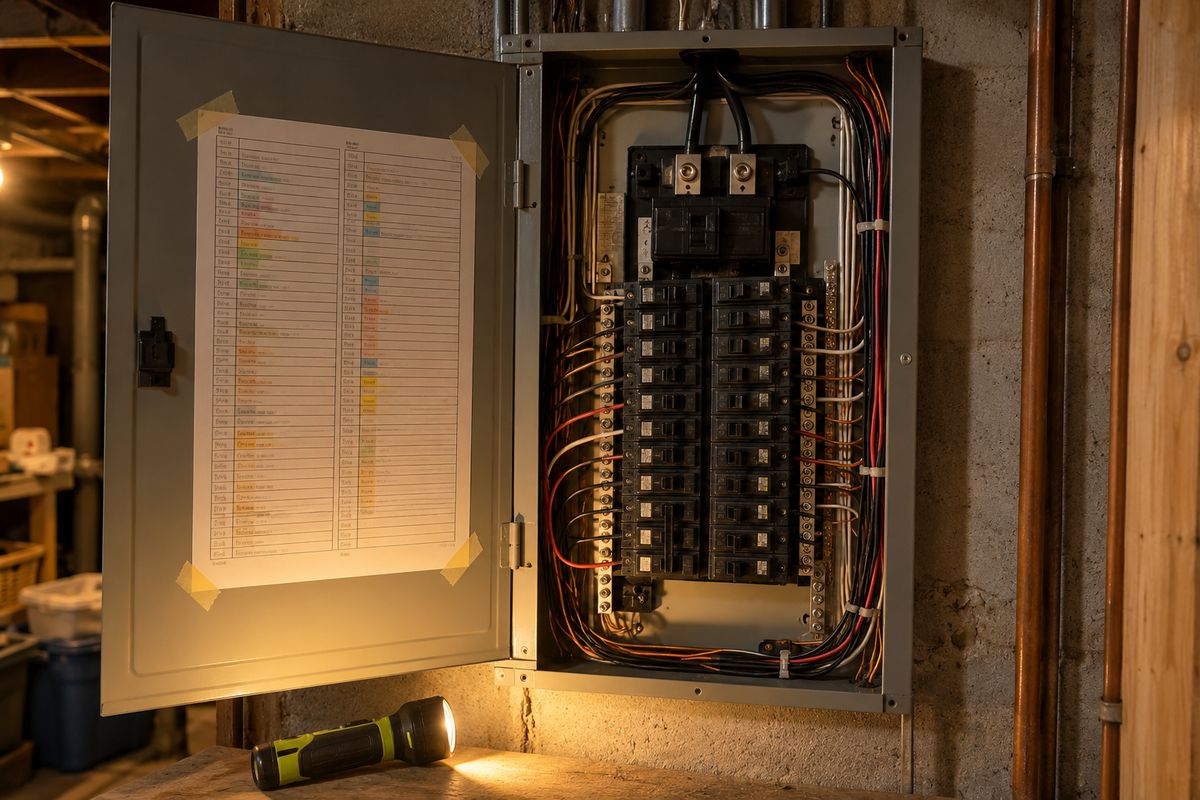
Tape it inside a panel door or clip it to the visor.
Checked 2026-10-19. Next recheck by 2027-10-19.
Sources
- AWG wire sizes: diameter in mils = 5 x 92^((36 - n) / 39), the definition in ASTM B258. For 1/0 through 4/0, n is 0, -1, -2 and -3.
- Copper resistivity of 10.371 ohm-circular-mil per foot at 20 C. Real wire varies with stranding, temperature and coating, so treat these as reference values.
- Aluminum resistivity of 17.002 ohm-circular-mil per foot at 20 C, the value used in this chart. Aluminum conductors are often sized up from copper, so check your code tables.